Marine Protected Areas – havens for marine wildlife?
Are you excited about protecting the oceans? Here is a quick overview of Marine Protected Areas (MPAs) for marine conservation enthusiasts, including what they are, a very brief history, current global coverage, and benefits to nature and people.

Picture by apasciuto/Flickr (CC-BY-2.0)
What is an MPA?
In 1988, the International Union for the Conservation of Nature (IUCN) defined a Marine Protected Area (MPA) as ‘any area of intertidal or subtidal terrain, together with its overlying water and associated flora, fauna, historical and cultural features, which has been reserved by law or other effective means to protect part or all of the enclosed environment.’ (1)
In other words, an MPA is any marine area where some kind of activity has been legally restricted. Therefore, there are many different types of MPAs in terms of their level of protection - the IUCN recognises seven categories of protected areas, ranging from a ‘Strict Nature Reserve’ to ‘Protected area with sustainable use of natural resources’.
A prime example of different protection levels is the Great Barrier Reef Marine Park in Australia. It includes 9 types of zones, including a ‘General Use Zone’, where most fishing and trawling is permitted, more restrictive ‘Habitat Protection’ zones, where trawling is not permitted, and no-take ‘Marine National Park’ zones, where no fishing or resource extraction of any kind is allowed.

Zoning of the Great Barrier Reef Marine Park. Source: https://www.gbrmpa.gov.au
How it started
The growth of MPAs is a trend of the last few decades. While some MPAs have existed for nearly a century. multiple events in the latter half of the 20th century led to the designation of nearly all current MPAs and the adoption of international targets for marine protection (2).
The First World Congress on National Parks (1962) is often attributed as the beginning of the global MPA movement. It encouraged countries to examine the possibility of creating national marine parks or reserves, and by 1970, 118 MPAs had been designated (2). In 1975, the Great Barrier Reef National Park was established, which to date remains one of the largest MPAs in the world.
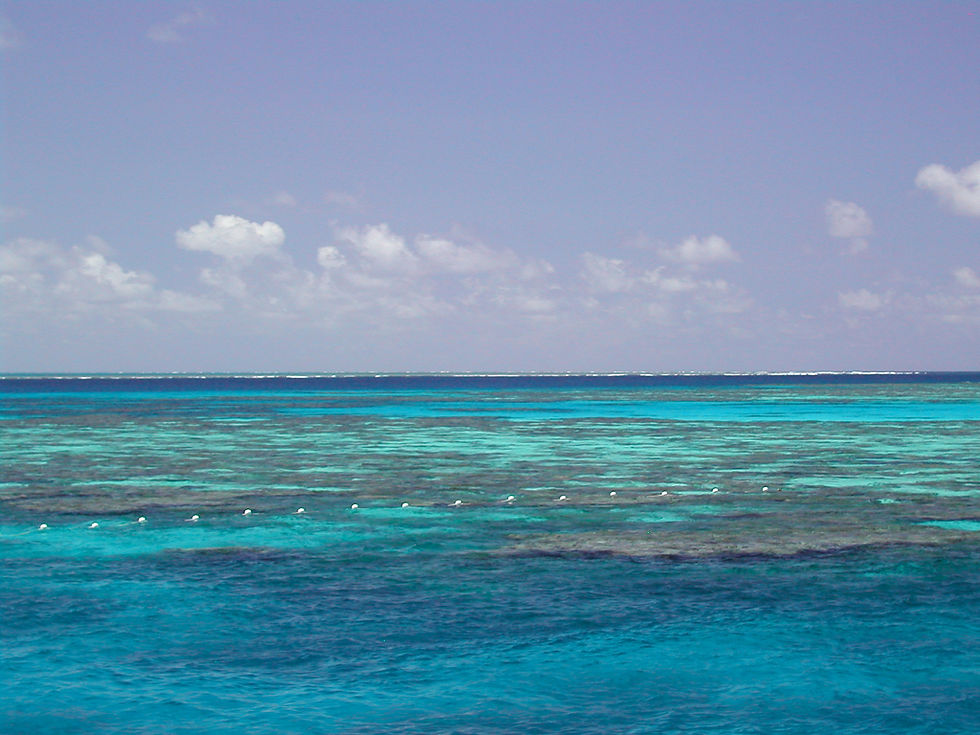
The Great Barrier Reef. Picture by Pete Edgeler/Flickr (CC-BY-NC-ND-2.0)
A decade later, the United Nations Convention on the Law of the Sea (UNCLOS) (1982) established a 200-nautical mile (370 km) band of coastal waters as the Exclusive Economic Zone of each country. Though it did not officially come into effect until 1994, the consequence of the agreement was that a third of all marine waters were now exclusively managed by individual countries for economic exploitation (2). This meant that individual countries would be responsible for establishing marine parks and reserves similarly to their terrestrial equivalents.
Throughout the next decades, the scientific recognition for the benefits of MPAs was growing. In 2004, the Convention on Biological Diversity (CBD), which most of the world’s countries are signatories to, set the first international target for MPA coverage at 10% of the world’s seas and oceans (3). However, by 2010 the target was not achieved, and the CBD’s new Strategic Plan for Biodiversity pushed the target to 2020. In 2014, The World Parks Congress recommended that 30% of the oceans be highly protected by 2030 (3).
Current coverage
As of January 2021, 6.4% of global marine waters are under implemented Marine Protected Areas, according to the Marine Conservation Institute (4). Fully or highly protected areas cover 2.7% of the global oceans, while 3.7% are less protected areas. Further 2% are in proposed, committed, or unimplemented zones. Explore an interactive map of the world’s MPAs on MPA Atlas.

Map of the World’s Protected Areas
93% of marine protection coverage is under very large MPAs (more than 100,000 sq.km, or 1.25 Scotlands) (5). Nearly 94% of all MPAs fall under the exclusive economic zones (EEZ) of countries, leaving more than 95% of the ‘high seas’ unprotected (5).
While the total area covered by MPAs is now slightly higher than protected areas on land, terrestrial protected zones cover a much higher proportion at 15% of global land (5). On the other hand, MPA coverage is growing much faster, more than doubling since 2010. Regardless, the global target for 10% MPA coverage was not met by 2010 and again by 2020.
In the United Kingdom (where most of the readers of this blog are likely to be), including overseas territories, 60% of Exclusive Economic Zone waters are under implemented MPAs, including 34% under fully / highly protected MPAs (4). However, focusing only on the EEZ around Great Britain and Northern Ireland, 41% of waters are protected, and nearly all of them in the less protected category (4). Browse the UK’s MPAs here.
Benefits to biodiversity
The effects of MPAs on marine wildlife are the best studied consequence of their implementation (6). Research has shown strong evidence that MPAs are beneficial to marine biodiversity and help ecosystems recover from human impacts, though studies have so far overrepresented no-take and tropical MPAs (7,8,6,9). Most effective for conservation tend to be MPAs that are large (> 100 sq.km), older than 10 years, no-take, well enforced, and isolated by deep water or sand (7,10). Due to less barriers to wildlife movement in marine compared to terrestrial habitats, large MPAs offer the opportunity to encompass parts of the ranges of many marine species. A recent analysis found that currently, large MPAs (>30k sq.km) cover at least some of the range of 83.3% of the 14 thousand species studied (11).
Socio-economic benefits
The socio-economic effects of MPAs are less well studied and more contentious – and nothing is more contentious than fisheries.
The problem of over-fishing can be addressed by MPAs. Zones where fishing is restricted to a certain level can allow fish populations to recover to a sustainable size. On the other hand, no-take fishing zones can allow even more rapid population growth within the zone, which can lead to more fish moving to zones where fishing is permitted. This is referred to as the ‘spillover effect’.
However, the effects of no-take MPAs on fisheries are contentious, with some studies claiming positive effects (10,12), while others claiming very small effects or unsubstantial evidence (6). In fact, while a big proportion of researches have focused on and advocated for more restrictive marine reserves, many have remained skeptical of the benefits of no-take areas to fisheries and claimed that their designation is often not justified by scientific evidence (13,14).
A recent review of 118 scientific articles, published in Nature, found overall positive effects to human well-being in 51% of cases, negative effects in 31% of cases, and ambiguous effects in 17% of cases (15). Effects were different for different stakeholders, with tourism and recreation seeing positive effects most often, fisheries benefiting in a majority of cases, but less often, and coastal communities seeing positive and negative effects at about the same rate. Like MPAs benefiting biodiversity, single-zone, no-take, high-enforcement and older MPAs were more likely to have positive effects on human well-being. In contrast to MPAs beneficial to biodiversity, small-size MPAs were most often beneficial to people, though large MPAs were also overall positive more often than not.
Conclusions
Marine Protected Areas, defined as marine zones where certain activities are legally restricted, are a tool used for marine conservation. MPA coverage has been rapidly increasing since the 1960s, and is currently 6.4% of the global seas and oceans. There are different levels of protection in MPAs, ranging from strict nature reserves to allowing a range of regulated activities. The benefits of MPAs to marine wildlife are well researched and widely accepted, but benefits to fisheries are contentious and socio-economic benefits are generally not as well studied. With more research and new area designation every year, the world of MPAs keeps expanding and there will always be a lot more to learn!
References
1. Guidelines for marine protected areas. (IUCN--the World Conservation Union ; Cambridge, U.K. : Available from IUCN Publications Services Unit, 1999).
2. Humphreys, J. & Clark, R. W. E. Chapter 1 - A critical history of marine protected areas. in Marine Protected Areas (eds. Humphreys, J. & Clark, R. W. E.) 1–12 (Elsevier, 2020). doi:10.1016/B978-0-08-102698-4.00001-0.
3. Global Conservation Targets » Marine Conservation Institute. Marine Conservation Institute https://marine-conservation.org/global-conservation-targets/.
4. Marine Conservation Institute. Marine Protection Atlas. https://mpatlas.org/zones/ (2020).
5. UNEP-WCMC, IUCN and NGS. Protected Planet Digital Report. Protected Planet Live Report 2021 https://livereport.protectedplanet.net (2021).
6. Caveen, A., Polunin, N., Gray, T. & Stead, S. M. Critique of the Scientific Evidence for Fisheries Benefits of MRs. in The Controversy over Marine Protected Areas: Science meets Policy (eds. Caveen, A., Polunin, N., Gray, T. & Stead, S. M.) 51–80 (Springer International Publishing, 2015). doi:10.1007/978-3-319-10957-2_5.
7. Edgar, G. J. et al. Global conservation outcomes depend on marine protected areas with five key features. Nature506, 216–220 (2014).
8. Lester, S. E. et al. Biological effects within no-take marine reserves: a global synthesis. Marine Ecology Progress Series 384, 33–46 (2009).
9. Ban, N. C. et al. Social and ecological effectiveness of large marine protected areas. Global Environmental Change 43, 82–91 (2017).
10. Sala, E. & Giakoumi, S. No-take marine reserves are the most effective protected areas in the ocean. ICES Journal of Marine Science 75, 1166–1168 (2018).
11. Davies, T. E., Maxwell, S. M., Kaschner, K., Garilao, C. & Ban, N. C. Large marine protected areas represent biodiversity now and under climate change. Scientific Reports 7, 9569 (2017).
12. Lorenzo, M. D., Guidetti, P., Franco, A. D., Calò, A. & Claudet, J. Assessing spillover from marine protected areas and its drivers: A meta-analytical approach. Fish and Fisheries 21, 906–915 (2020).
13. Leenhardt, P., Cazalet, B., Salvat, B., Claudet, J. & Feral, F. The rise of large-scale marine protected areas: Conservation or geopolitics? Ocean & Coastal Management 85, 112–118 (2013).
14. Caveen, A., Polunin, N., Gray, T. & Stead, S. M. The Controversy over Marine Protected Areas. (Springer International Publishing, 2015). doi:10.1007/978-3-319-10957-2.
15. Ban, N. C. et al. Well-being outcomes of marine protected areas. Nature Sustainability 2, 524–532 (2019).
Comments